• Sari la conținut

BobbyVoicu.ro

  • Home
  • Arhiva (2005-2013)
  • Home
  • Arhiva (2005-2013)

Arhiva completă

  • Toate
  • Română
  • English

Best acting I've ever seen

ENîn engleză Misc · January 16, 2020

I’ve been watching The Crown in the last week or so. Yesterday I got to episode 9 of the first season, called Assassins (light spoiler ahead).

The context is this: Winston Churchill sits for a portrait with a famous painter – Graham Sutherland. It’s the Prime Minister’s 80th birthday and he was given the opportunity as a present.

There’s a short scene when the character (Churchill, played by John Lithgow)) realizes that he painted a pond 20 times or more because it reminded him of his dead daughter.

The painter says this to him, before the scene (which starts at 35:30 in the episode, by the way):

I was thinking especially of the Goldfish pond here at Chartwell. It’s very much more than that. As borne out by the fact that you’ve returned to it again and again. More than 20 times.
[…]
I think all our work is unintentionally revealing and I find it especially so with your pond.

Beneath the tranquility and the elegance and the light playing on the surface, I saw honesty and pain, terrible pain. The framing itself indicated to me that you wanted us to see something beneath all the muted colors, deep down in the water.

Terrible despair. Hiding like a Leviathan. Like a sea monster.

Then you can see on Churchill’s face the agony, the pain, the longing, the missing. Everything a human being can feel, you could see in those 30-40 seconds. No sounds, no words. Just his face. And you could feel how much pain there was inside him.

It’s the best acting I’ve seen. Ever.

I wish I was able to be that good at something in my life as John Lithgow is good at acting.

Later update: after writing this, I’ve started to read about the portrait. And I’ve found out that John Lithgow won the Primetime Emmy Award for Outstanding Supporting Actor in a Drama Series for this exact episode.
Space for Disorganization: The organized chaos we all need

ENîn engleză Quality of Life, Tools I Use · January 19, 2020

There was a joke in communist Romania:
“At an exam for policemen, they are given a ball and a cube and a board with two holes: one round and one square. The task: fit the cube and ball through the board in front.

The conclusion of the exam:
5% of the policemen are quite smart, 95% are really strong.”

While I’m not a policeman in communist Romania, that’s me. That’s you, I bet, as well: you try to clean and organize your office. Your room. Your email account. Whatever. And you find things you don’t really know what to do with. And you try to push them into a set of categories you already established for your stuff, but it doesn’t really work.

I feel it’s the same thing when you’re trying to organize your life/space in any way. We’re really, really strong: we’re trying to fit stuff in categories it doesn’t fit and it’s never completely as it should be.

The solution: a Space for Disorganization. A space where you dump things you don’t know where to put yet. Or you don’t have the time right then and there. As Janet and Isaac Asimov say:

It also helps to have one – and only one – Space For Disorganization, a shelf or drawer where things can be dumped until you have time to be neat, methodical, and are able to make decisions about where things should go. When you think you’ve lost something, it will probably be in the space for disorganization.

And if you wait long enough you’ll find that more of its contents can be just thrown out, and the process of doing so can serve as a Constructive Activity to Raise Self-esteem.

I found this quote in How to Enjoy Writing by Janet and Isaac Asimov.

And I’m actually doing something akin those lines, even if I never defined it. Especially now, when I’m putting together my home office in the new house.

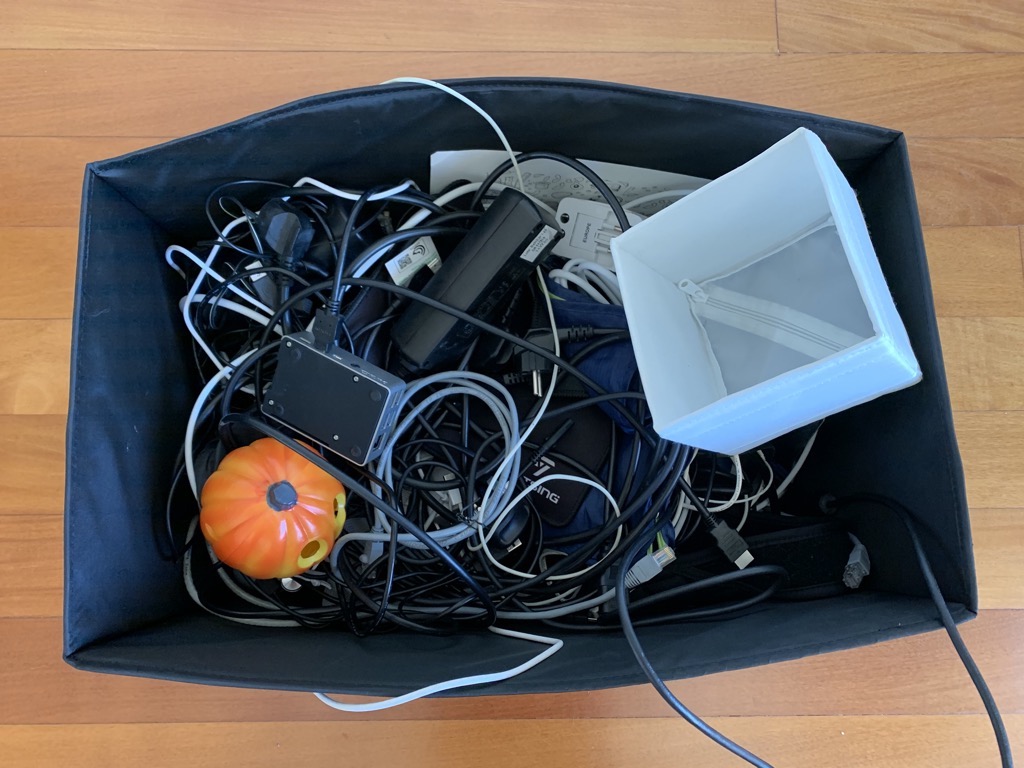
Here it is, my Box of Disorganization, in the photo below. It’s filled with cables, gadgets, batteries, device manuals, I even see a Halloween decoration piece on top there.

I also have a similar space in Evernote, which is my tool of choice to get things from around the web that I “might” need at some point. Including the links you read in the weekly newsletter I send.

The “Space for Disorganization” in Evernote is a notebook called _Inbox. That’s where I drop everything that’s not specifically targeted for something. And every 2-3 months I go through the notebook and see if what I saved has a more specific place. If not, it just goes to another notebook, called Reference, where I might find it in the future using the search function of the app.

The advantage, for me, for the existance of a “Space for Disorganization”?

It doesn’t generate “paralysis by analysis”.

If I don’t think of a specific place for some thing or for some information, it goes straight to the Space. Also, as you know, small decision sap your energy. Because there’s no effort to think too much about what I need to do with something, I lose less energy on these small decisions, of where to put what. This allows for more energy to organize my space and keep it clean. Physical space or online space.

Keep in mind, though, it needs to be only ONE Space for Disorganization. If you have more than one, you just made a really good system of being disorganized.

Do YOU have a Space for Disorganization? As you can see, even a box from IKEA works.

Stupid ideas: the good, the... good?

ENîn engleză Entrepreneurship, Startup Founder · January 24, 2020

“I just started a gaming company and we make Solitaire games!”
“Well, that’s stupid!”

That was me in 2012, telling a friend about the new project I just started. He still is my friend (I know!) and he is a smart guy. And he genuinely thought it was a stupid idea. And I still remind him of that discussion.

Of course, that’s what started MavenHut. We built that initial Solitaire game (Solitaire Arena) to a company with 35 people and more than 40 millions players.

Do you know there’s a guy that wanted to start a marketplace for people to rent inflatable beds in their apartments? Or a guy that thought internet was good for selling books? Or some guys that thought they could build a site helping you leave it the moment you visited it? Yeap, they’re Airbnb, Amazon, Google. They all seemed really stupid at the moment.

I love stupid ideas. I like talking about them. I know most of them will never become a business, a company or even a side project. But come on, don’t you want to let your mind wander and wonder?

I prefer, as Tynan says here, to see the good in the ideas. That’s why I almost never say “don’t do this“. I just say “what stops you from trying?”

That being said, no matter how much I love talking about stupid ideas, I would not invest in them. I mean, I can’t afford a 1 in 1,000 chance of something working.

I will never put down a stupid sounding idea, though. After all, I’ve founded a company making Solitaire games. “How stupid is that, when you can play it for free on Windows?”

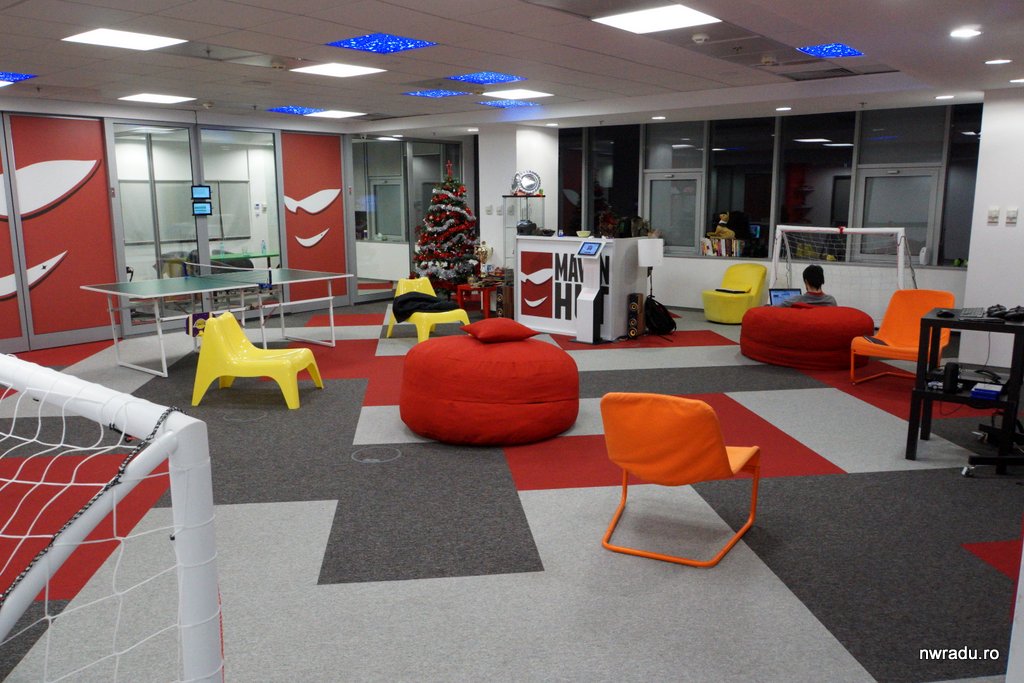
The image above is of the MavenHut offices in 2014. I took it from Radu.

Books to Read in February 2020 [Poll] - The CEO Library Book Club

ENîn engleză The CEO Library, To Read · January 28, 2020

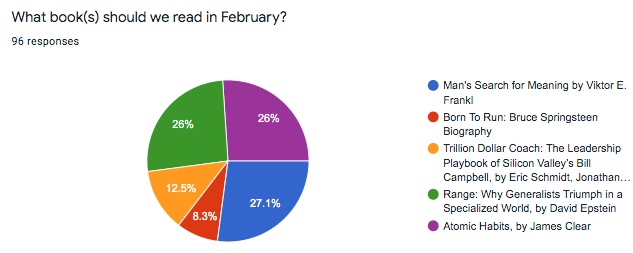
Update: Here are the results:

  1. Man’s Search for Meaning – The Classic Tribute to Hope from the Holocaust, by Victor E. Frankl
  2. Atomic Habits: An Easy & Proven Way to Build Good Habits & Break Bad Ones, by James Clear
  3. Range: Why Generalists Triumph in a Specialized World, by David Epstein
  4. Trillion Dollar Coach: The Leadership Playbook of Silicon Valley’s Bill Campbell, By Eric Schmidt, Jonathan Rosenberg, Alan Eagle
  5. Born to Run, by Bruce Springsteen

Here’s the first poll for The CEO Library Book Club:

Updated: March 11 - The Economic Impact of The COVID-19 (coronavirus) Outbreak

ENîn engleză Misc, To Read · March 2, 2020

I’m reading some interesting articles on the potential economic impact of the coronavirus outbreak. Here are some of them (the newest I find are at the top of the list below):

  1. What If We’re at War?
  2. How the coronavirus will shape the future
  3. What to expect next with the coronavirus
  4. Coronavirus: The Black Swan of 2020
  5. Pandemics Are More Than Just About The CFR
  6. Covid-19 is teaching hard lessons about China-only supply chains
  7. COVID-19 may be the black swan that pushes the global economy into recession

I’m gonna add more articles to this list as I find them, since I’m really interested to understand what can happen.

Also, I just published a new book collection on this subject: Books on Bioengineering, Pandemics and Viruses.

If you have any suggestions for articles on this subject, please comment below or send them via email: community AT this site.

Install Visual Studio Code on Raspberry Pi

ENîn engleză Misc · March 22, 2020

Later edit: Now Visual Code is part of Raspberry Pi OS, here is how to install it.

From here:

Open a new terminal. If you need super-user rights (you probably do), then you can enter sudo -s and press return to enter a super-user session. Run the installer for your current distribution:

APT instructions

(including Debian, Raspbian, Ubuntu and Linux Mint)

. <( wget -O - https://code.headmelted.com/installers/apt.sh )

Press the return key. Once the installer has completed, you should have a “Code – OSS” entry in your desktop program list.

Headmelted

If you want to use Visual Studio Code on Raspberry Pi, this is the easiest solution I’ve found.

"Natural" Mouse Scroll for Windows 10

ENîn engleză Misc · March 29, 2020

After around 10-12 years of using just MacOS and the occasional Linux, I finally got a Windows machine again, to use for some light gaming on Steam.

One of the things you get used from the world of Mac, for good or for bad, is the “natural” scrolling for the mouse. Unfortunately, in Windows 10, if you don’t have a touchpad, you don’t have the option in Settings.

I found this solution, using Windows Registry:

Use the Windows key + R keyboard shortcut to open the Run command.

Type regedit, and click OK to open the Registry.

Browse the following path: Computer\HKEY_LOCAL_MACHINE\SYSTEM\CurrentControlSet\Enum\HID Quick tip: On Windows 10, you can now copy and paste the path in the Registry’s address bar to quickly jump to the key destination.

Expand the key (folder) that matches the VID ID of your mouse — for example, VID_0E0F&PID_0003&MI_01.

from WindowsCentral.com

There’s a little bit more than the steps above, so go to WindowsCentral for the full list of steps, in case you have this issue.

Transpose and Remove Duplicates in Google Sheets (Docs)

ENîn engleză Misc, Tools I Use · April 6, 2020

I’ve had to do some cleaning for a list of numbers recently and I used Google Docs for that. Of course, I used the Excel equivalent, Google Sheets.

Since it’s not the first time I looked for this information, I thought I would put it here, in case I ever need it again. And in case anybody else needs it.

How to TRANSPOSE cells in Google Docs (Sheets)

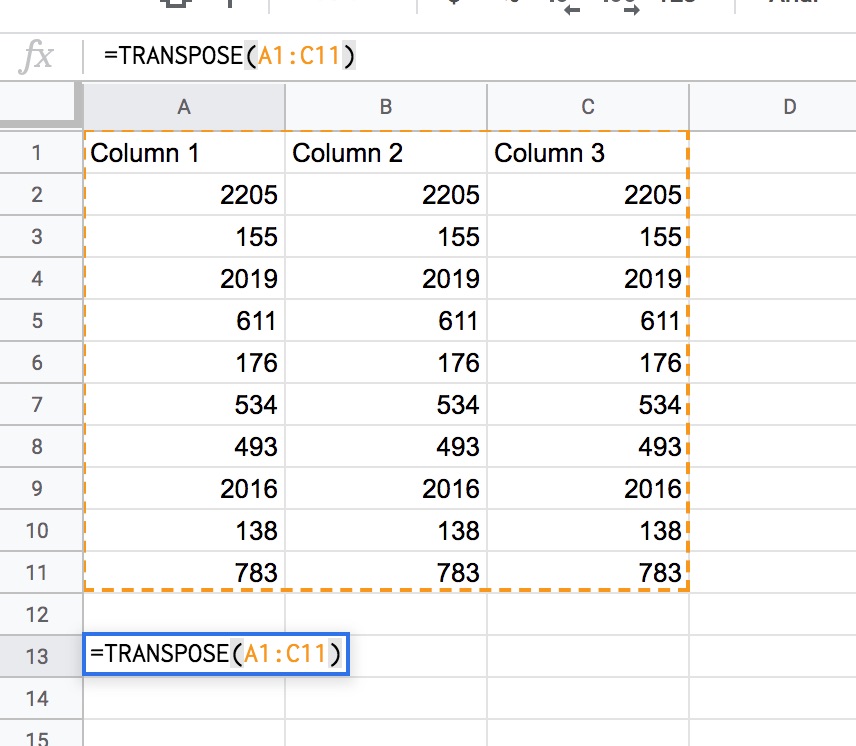
  • Use this function: =TRANSPOSE(A1:C11)
  • Change A1 and C11 with the top left and bottom right, respectively. You can see how in the image below.

How To Remove Duplicates in Google Docs (Sheets)

This is even simpler.

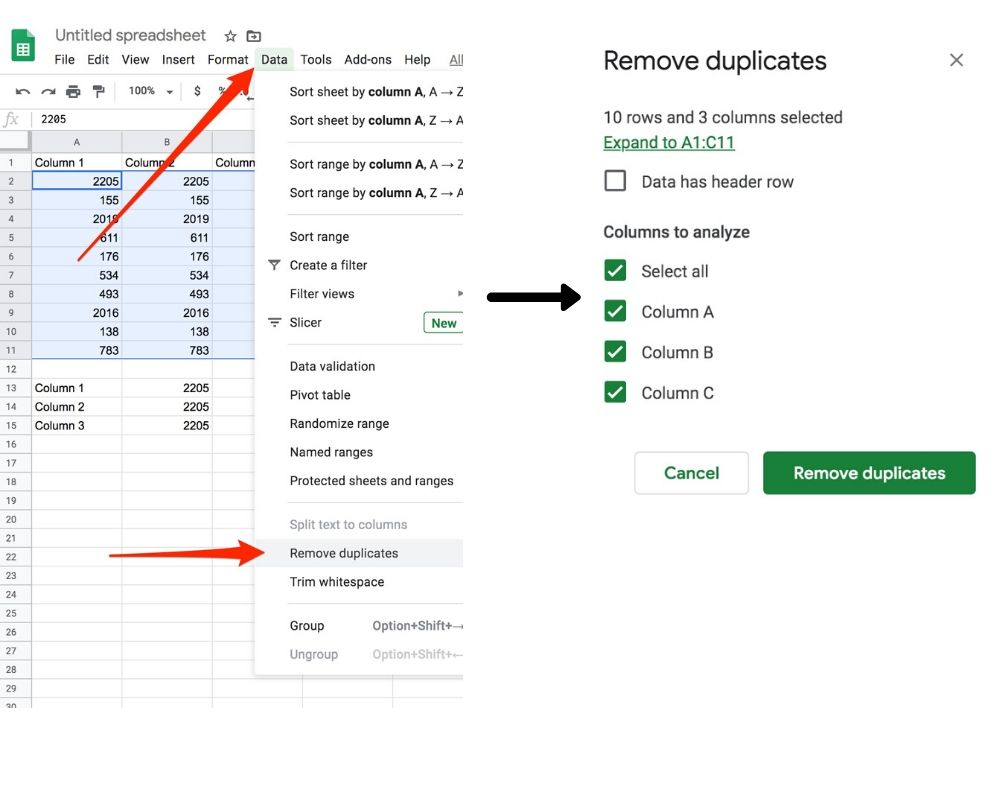
  • Just select all your fields (or not, since you also have the option of remove duplicates in the entire sheet).
  • Go to Data -> Remove Duplicates in the top menu (see the image below).
  • Then you are taken to another window, where you can select exactly where you want to remove the duplicates.
  • And that’s it!

Used Lenovo ThinkPad Buying Guide

ENîn engleză Misc, Tools I Use · May 3, 2020

I’ve been looking to buy a cheap Lenovo ThinkPad to play with Linux distributions (later edit: I bought a t440s, update at the end of the post). I’ve lost contact with the PC laptops world a while ago, so I needed to find a good source of information.

This is the best I found:
Used ThinkPad Buyer’s Guide

Used ThinkPads are cheap because they are business-grade computers – and business-grade equipment is purchased new typically every 3-4 years. This is fantastic for the smart or thrifty, as software requirements haven’t changed much since mid 2011. Even better, business-grade PC’s tend to last far longer, and function far more consistently than consumer or even ‘prosumer’-grade technology.

This is a freely offered guide on technology that I, and many others, consider to be the best of the best. That said, your mileage may vary – I can’t promise how much you will like it. :)

It covers everything you’d want to know about the devices.

The only thing that is a bit annoying (not the author’s fault in every way) is that the prices in EU are quite a lot bigger than the ones mentioned (from the US second-hand market). Sometimes it’s even double the price.

Here’s another good guide, if you want to compare advice, just to be sure.

Reddit helped again.

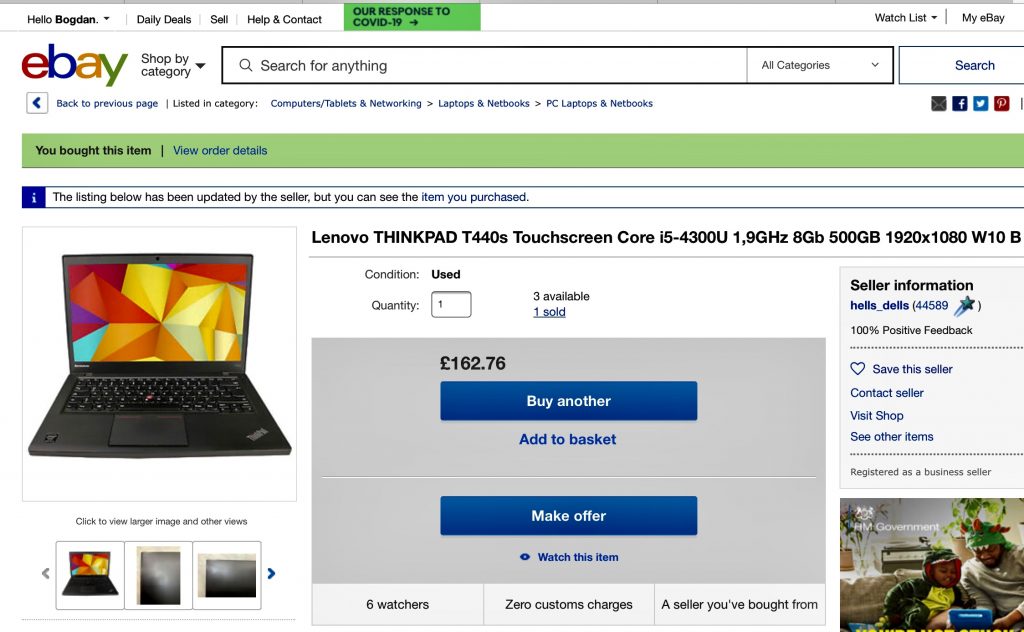
Later update: In the end, I bought this T440s, from eBay, for about €195 (didn’t receive it yet):

  • Lenovo THINKPAD T440s
  • Touchscreen, 1920×1080
  • Processor: Core i5-4300U @ 1,9GHz
  • RAM: 8GB
  • HDD: 500GB – I’ll probably swap it with an SSD

Featured image credit: wikipedia.

Supercell's business deconstructed

ENîn engleză Game Development · May 6, 2020

When we were growing MavenHut, one of the models we used was SuperCell. I’ve actually used their business model to convince our investors to put more money into MavenHut.

The company created several games and generated $12.5 billions in 6-7 years with just a few employees (300) compared to other gaming companies.

It’s an amazing story and I’m happy I’ve found this article:
10 Years of Excellence – Deconstruction of Supercell

If you’re interested in gaming, this is mandatory reading. If you’re interesting in startups, the same.

Supercell is one of the rare companies that doesn’t try to beat the competition; rather, it tries to beat the high score set by its own prior games. To date, Supercell has created multiple genre-defining games and generated billions in revenues — all with little more than 300 employees (!).

[…]

There are only a handful of companies that try to disrupt the market by creating new genres or redefining existing ones. Disruptors rely on gut feeling, an extremely high level of talent, and… a lot of courage to pull off this high-risk, high-reward strategy. Supercell has clearly mastered this strategy so far, since they can be credited for creating 4 genre-defining hits: Hay Day, Clash of Clans, Clash Royale, and Brawl Stars. This is an astounding achievement as most disruptors are lucky to produce a single hit of that magnitude in their lifetime.

These are just some of Supercell’s incredible achievements so far:

  • $12B in total gross revenues over the last 6 years (mic drop)
  • Its first 4 games passed $1B in lifetime revenues (and Brawl Stars will soon join the club)
  • Long “staying power” of its games, as they remain relevant for years
  • Clash of Clans is one of the most successful mobile titles ever (revenues estimated ~$6.5B)
  • Global footprint (in 2019 ~40% of revenues came from the US and ~15% from Asia)
  • Well diversified portfolio across genres (from simulation to build & battle and MOBA)
  • Currently only 320 employees to achieve all of the above

However, no matter how big of a fan of Supercell you are (and we at Deconstructor of Fun for sure are), you can’t overlook the numbers. In the last few years, Supercell has been on a gradual decline, as existing titles have slowed down and new launches haven’t been able to fill the void.

Again, read the entire article, it is worth it! And read the entire Deconstructor of Fun blog, while you’re at it.

  • « Previous Page
  • Pagina 1
  • …
  • Pagina 165
  • Pagina 166
  • Pagina 167
  • Pagina 168
  • Pagina 169
  • …
  • Pagina 185
  • Next Page »

Despre

Scriu. Fara un subiect anume, fara o tema anume.

Aici e o arhiva a perioadei 2005-2013, cand scriam ceva mai des pe blog.

Scrise recent

  • Logo-ul Blanket
  • Elogiu pentru o tastatura: Thinkpad T480
  • Cartile din 2025
  • Bucuria de a fi iritat (si, probabil, iritant)
  • Cum sa iti dai seama la ce esti bun(a)

Proiecte

  • BobbyVoicu.com
  • MixRift

Copyright © 2026 · BobbyVoicu.ro