• Sari la conținut

BobbyVoicu.ro

  • Home
  • Arhiva (2005-2013)
  • Home
  • Arhiva (2005-2013)

Arhiva completă

  • Toate
  • Română
  • English

Do pandemics ever completely end? Sometimes...

ENîn engleză To Read · April 14, 2021

I genuinely love this kind of articles, animated and full of information. This is particularly interesting because it’s about the last 1000 years of pandemics for humanity and what happened with them.

I, for one, didn’t know the bubonic plague still kills people now (even if not a lot, sure) and that smallpox is the biggest ever success for vaccines, since it is the only human disease completely eradicated.

And as the eradication of smallpox proved, when the world’s scientific community comes together, great things are possible.

Although the new coronavirus is a much trickier challenge, because of its high levels of asymptomatic transmission, Prof Riley is optimistic the “incredible” global quest for a solution will win through.

“The world has never had a shared project like this before,” he says. “Hopefully it becomes a shared success at some point.”

However, it may serve us well to remember that most of the pathogens that rampaged through societies in pandemics in the past are still around. While the crises ended, the viruses and bacteria – and their resulting infections – remain.

From here: Covid-19: How do pandemics end? – BBC News.
The first 18 months of a startup

ENîn engleză Entrepreneurship · April 14, 2021

This is a good Twitter thread to remind you what the first stage of your startup is about.

The full thread is here, on Twitter, from @Suhail. I’ve also saved it completely below, so I can go back to it when I forget.

1/ The first 18 months of a startup:
After starting my 2nd company in 2019, I decided I would write down useful lessons I learned or re-learned along the way. Some were hard-earned & others required steady focus. A thread that I hope may help other founders starting out

2/ Clarifying your plans: the first thing I did was write down a 7-page Elon Musk- style master plan. Write down what problem you plan to solve, how you’ll solve it, and why it’s important. Then have your smart friends critique it. Let no valid question go unanswered.

3/ End every conversation with an expert about your industry with: “Why do you think I am going to fail?” to lean into brutally understanding what you need to de- risk.

4/ Think of a way to make your users have some skin in the game enough to yell at you to make your product better. Charge or trade for it early on. Waiting for your product to be “good enough” reduces the amount you’ll learn each day. The first set of users paid me $20 on Venmo!

5/ Occasionally someone you respect will give you unsolicited advice that may cut you down. First, absorb it. Later, try to put their advice in a way you would’ve wanted to give yourself. This removes the hurtful part allowing you to hear it in a way you can benefit from.

6/ Rolling out of bed in my pajamas and getting back to work with things precisely as I left them was the most underestimated superpower that brought me joy, focus, and speed—I had forgotten how much goes into getting ready for work.

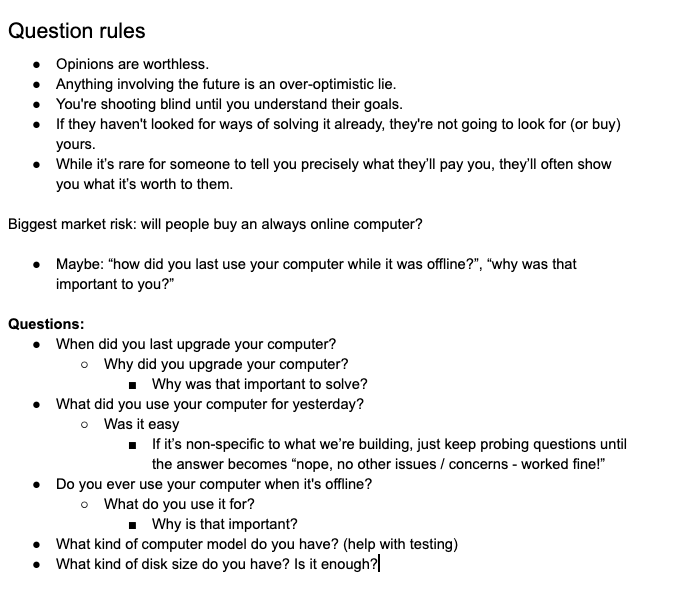
7/ Learning from users is a practiced skill just like programming. If you don’t have experience, make a plan. Start with simple questions, then go deep.
Here was mine going into early customer interviews:
👇

8/ Be married to the problem, not the technology. If you’re married to technology, you might easily give up due to stress induced by setbacks or boredom. Being married to the problem will motivate you to have the perseverance to continue through hard times or tedious work.

9/ As your relationship with your co-founder changes, there will be times of tension. Confront issues early. Be explicit about how you will divide & conquer. Lean on each other’s passions. Don’t confuse working style differences with how the company ought to work. Get a coach.

10/ I think startups often take half pivots early on. Mine did. The 1st idea might be wrong but if you stick w/ it a bit longer, you’ll often discover a deep problem people care about. All that’s stopping you is if you want to run that company to achieve that particular mission.

11/ Sometimes smart people didn’t like my idea. You don’t need to persuade everyone! Instead, I used it as an opportunity to understand their opposition & worked hard to see the truth of their opinions. I used it as a moment to strengthen my understanding from a smart critic.

12/ During the first 6 mo of my startup, I largely focused on the eradication of risk: Will people want this? Will people pay? Can this make a profit? Can it scale one day? Will the tech work? All in the pursuit of what will kill me? You just need to know there’s a solution.

13/ If you’re worried about something that will cause your inevitable demise, use my patented Threshold of Worry ™:
1. Set a quantitative value for the worrisome issue.
2. If it’s above the value, worry!
3. If it’s below the value, focus on the next risk & ignore

14/ Every month I ran my current goals/plans by another founder outside of the company. I found it better to assume my current thinking had a subtle fatal flaw I couldn’t see. That will often save you time or make you think differently enough to break out of a local maxima.

15/ Early on, each hire should be a little anti-sold before they join vs only passionately persuaded. Every startup has setbacks, makes mistakes, might pivot, and must overcome unforeseen obstacles. The early team must be sufficiently optimistic & capable of rapid recovery.

16/ Momentum is oxygen for a startup. Without momentum, you let fear, uncertainty, and doubt cause your demise.

17/ When building a startup:
If you have fear, de-risk by talking to users.
If you have uncertainty, build a prototype to rapidly rebuild your conviction. If you have sudden doubt, sleep. Try again tomorrow.

18/ The first goal I set for our company was narrow: make 10 happy users use our product. A happy user uses it, pays for it, and organically praises it. Focusing on a few wonderfully happy users is a better recipe for great retention. Then go from 10 → 100 → 1K → 10K → 100K.

19/ I was ruthless about ensuring I had as much deep work time as possible. Live somewhere boring. Eliminate meetings. Don’t meet investors if you’re not raising. Build a rhythm each day that enables the largest chunk of hours to get great work done. Users will notice your pace.

20/ If you’re a 2nd-time founder, resist the urge to button everything up. It’s a trap that makes you think you’re doing meaningful work. The first time around this blissful ignorance helped me focus on what mattered most: making a great product. It’s okay for things to be messy

21/ Your company culture doesn’t need to be set & written in a handbook on day one. I think culture is best formed organically & needs time to bake with a small team. From there, you can discover what works & what breaks. The values of a company need not be preserved, they evolve

22/ Last but not least: talk to users. talk to users. talk to users. talk to users. talk to users. talk to users. talk to users. talk to users. talk to users. talk to users. talk to users. talk to users. talk to users. talk to users. talk to users. talk to users. talk to users.

I’ve put the list of twits together using ThreadReaderApp, a really good service for something like this.

What is the hardest thing you ever worked at?

ENîn engleză Quality of Life · April 15, 2021

What is the hardest things you ever worked at?

It’s such an interesting question, right? When I thought about it, I immediately thought: “MavenHut”! I’ve never felt as tired as I felt while building that company, so that was my first answer.

But was that the hardest thing I’ve ever worked at? I mean, yeah, it was hard WHILE doing it, but I didn’t specifically work hard to create that opportunity.

Then I thought of a big campaign I’ve been a part of creating and running while I was blogging: Rediscover Romania (Redescopera Romania). That was hard as well, but again, it was hard while doing it, not working AT it.

And I think I worked the hardest at my relationships: with my family (didn’t really have a great relationship with my mom), with my fiancée (it was really difficult for both of us during my hardest MavenHut years).

What is the hardest things you ever worked at?

It’s an interesting because I always thought the hardest I worked at something was my businesses, my career. But if I look at it, it never seemed as hard as it was working on building and maintaining relationships with the people that matter to me.

It’s an interesting question because it asks you how much you WANTED something, how much effort you put into something happening. And that’s a lot different than the effort you put into something while it happens.

Oh, and I got the question while listening to the Building Bridges podcast episode with Toni Cowan-Brown from Idee Fixe newsletter.

Photo by Jordan Whitfield on Unsplash>

How People Get Rich in 2021

ENîn engleză Entrepreneurship · April 18, 2021

The best way to build wealth from scratch right now is building a company. So what are you waiting for?

In 1982 the most common source of wealth was inheritance. Of the 100 richest people, 60 inherited from an ancestor. There were 10 du Pont heirs alone. By 2020 the number of heirs had been cut in half, accounting for only 27 of the biggest 100 fortunes.

Why would the percentage of heirs decrease? Not because inheritance taxes increased. In fact, they decreased significantly during this period. The reason the percentage of heirs has decreased is not that fewer people are inheriting great fortunes, but that more people are making them.

How are people making these new fortunes? Roughly 3/4 by starting companies and 1/4 by investing. Of the 73 new fortunes in 2020, 56 derive from founders’ or early employees’ equity (52 founders, 2 early employees, and 2 wives of founders), and 17 from managing investment funds.

From here: How People Get Rich Now.

I didn't know one of the Adobe founders was kidnapped for ransom in 1992

ENîn engleză Misc · April 18, 2021

One of the founders of Adobe, Charles Geschke, died recently, at 81. He is the guy that brought PDF into our lives. You can read more about his life in this Verge article.

But what I found it interesting was that he was kidnapped at some point in his life for 4 days, by some people asking for a ransom. I mean, I never thought a tech executive life would be so exciting (with the exception of John McAfee, of course). Truth is I’m surprised we don’t hear about more new like this, seeing how much wealth is focused in the Bay Area.

A computer software executive kidnapped at gunpoint four days ago was freed Saturday when a suspect caught with $650,000 in ransom money led authorities to a bungalow hideout, the FBI said.

Charles Geschke, 52, president and chief operating officer of Adobe Systems Inc., had been in the house in Hollister, 60 miles south of San Jose, since he was seized by two men as he arrived for work Tuesday, FBI agents said.

″The two men called him to their car to ask him a question, then at gunpoint took him away and secreted him,″ said FBI agent Richard Held. Geschke was abducted at the company’s headquarters in Mountain View, about 10 miles northwest of San Jose.

From here: Computer Company Executive Rescued By FBI.

A Real Life Robot Cue Stick Playing Pool

ENîn engleză Game Development, Misc · April 19, 2021

You know how sometimes you go on YouTube and you discover a video that grips you and makes you forget about anything for a while?

I’ve just found a video about a guy that created a robot cue stick to play pool with you in real life. Yes, like an online pool game in real life… which kinda makes and doesn’t make sense at the same time.

It’s more than that, because the robot knows what ball to play, when to play, how hard to hit the cue ball… it’s AMAZING!

Watch the video below and thank me later for making you lose 20 minutes of your day:

Clubhouse Clones List

ENîn engleză Misc · April 20, 2021

I just found out that Reddit wants to launch their own Clubhouse clone. Which actually kinda make sense, as opposed to LinkedIn doing the same.

Here’s a list of Clubhouse clones, updated as I find out more:

  1. LinkedIn
  2. Twitter Spaces
  3. Reddit
  4. Facebook
  5. ByteDance (TikTok)

Photo by Bimata Prathama on Unsplash

India’s 2nd Wave of COVID: A Lesson in Exponential Growth

ENîn engleză Misc · April 24, 2021

India is going through what is, probably, the worst COVID wave in the world since the pandemic started.

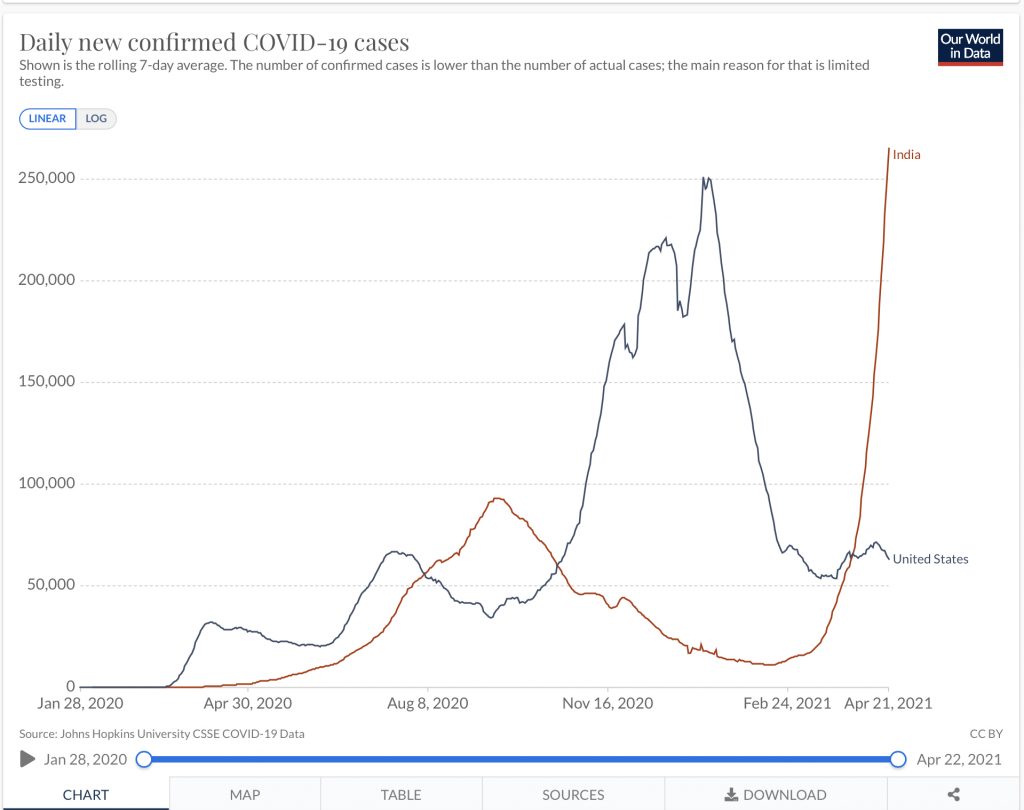
What should make us pay attention, even in the countries that fare better now, is how fast things changed to the worst of the worst: in February India had 11,000 new COVID cases per day and now, in April, has more than 300,000/day.

It’s easy to forget what exponential growth means when you look at 500-600 cases per day in Portugal (where I live), but it’s so easy to get to huge numbers in a short period of time. Actually, Portugal just got out of a 3 months quite strict lockdown. We needed it because we jumped from less than 1,000 cases to 15,000 cases per day in less than 3 months (from late October to end of January), after not locking down for Christmas.

chart from here

Having this many new cases per day also means a better chance for the virus to mutate into a more resistant strain.

India’s total eclipsed the previous one-day high of 300,669 recorded coronavirus cases, set in the United States on Jan. 8, according to a New York Times database, though differences in testing levels from country to country, and a widespread lack of tests early in the pandemic, make comparisons difficult.

Over the past two months, the outbreak in India has exploded, with reports of superspreader gatherings, oxygen shortages and ambulances lined up outside hospitals because there were no ventilators for new patients.

More details on what happens in India here

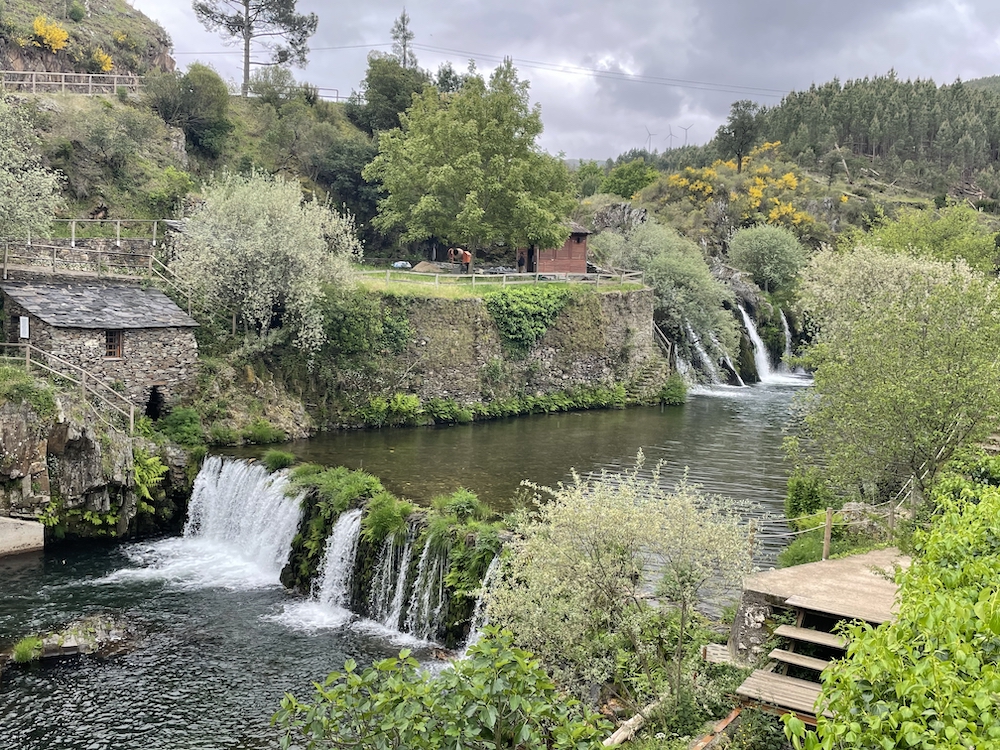
Portugal by Car: Cascade Poço da Broca da Barriosa

ENîn engleză Portugal · April 25, 2021

I love driving. While living in Romania I was part of a big online promotional campaign that took online influencers driving around Romania to see the great places in the country. It was called Rediscover Romania and I drove a lot.

Now, living in Portugal, I’m trying to do something similar, but the only “influencer” I take to these places is myself.

After being in lockdown for about 3 months (it’s April 2021 now), we finally can drive around and I looked at something close enough to be a day drive. Which is all the country, frankly, if you live in the Northern half, from Lisbon up, and you don’t want to visit the South (Algarve or Alentejo).

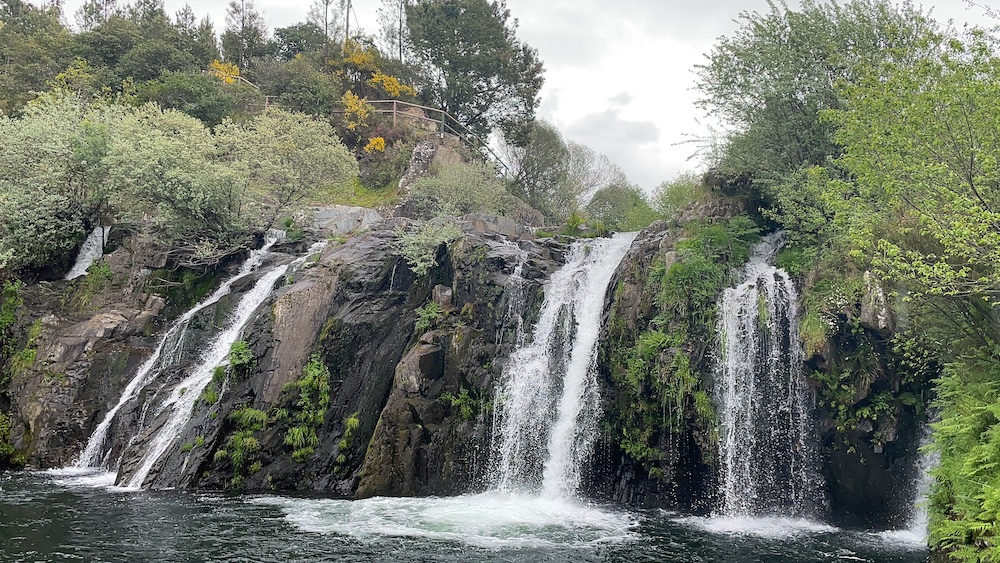
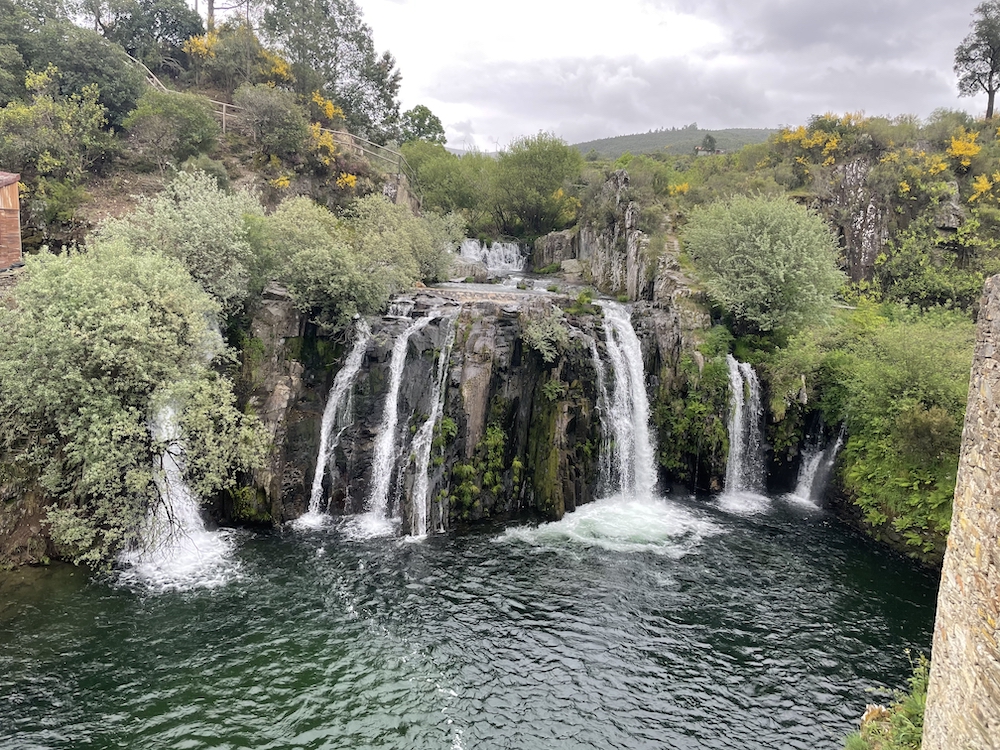
I wanted to go to Serra da Estrela, initially, which is the highest peak in continental Portugal, but as I was looking around on Google Maps, my eyes were drawn to something called Poço da Broca (GMaps location). When I saw that it was a nice cascade, I was sold. And the truth is it isn’t just nice, it’s quite beautiful.

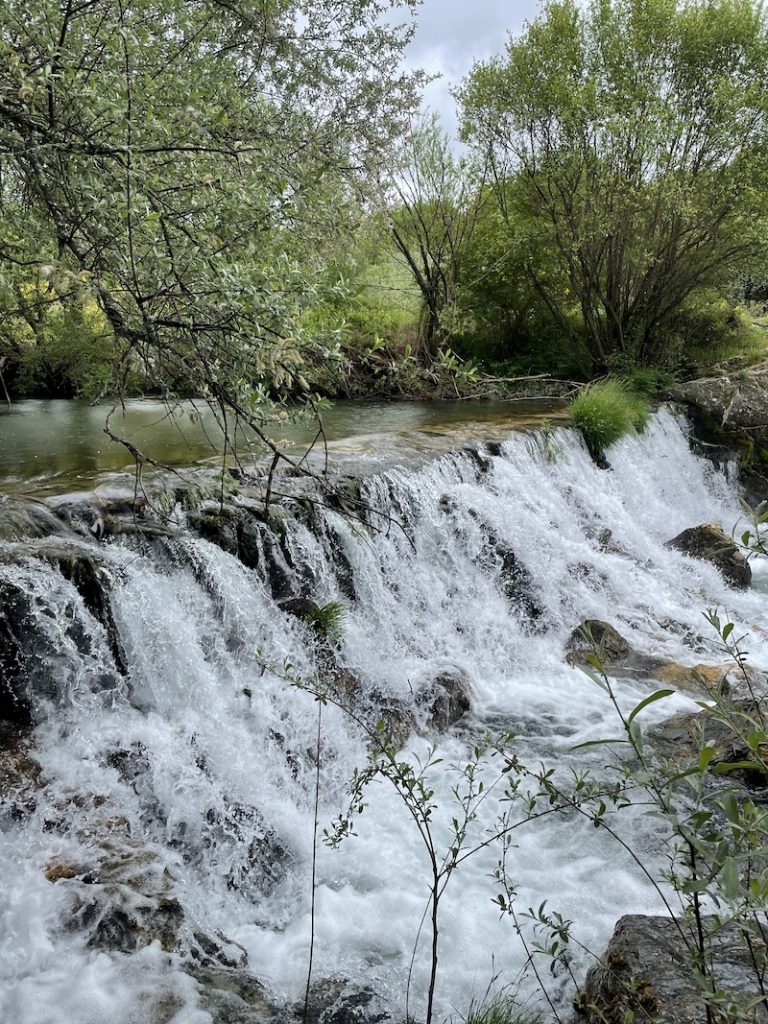
Poço da Broca is a series of cascades above schist rock, on the river Alvôco. It’s close to Barriosa village, about an hour of driving from Coimbra, 2 hours from Porto and a little bit more than 3 hours from Lisbon. It actually makes even more sense if you go to some schist villages in the area, as well.

I was there during a Wednesday, on a rainy day, so there were almost no people around, but I heard that even during the peak season it’s not too busy. There’s a restaurant on location, but it was closed when I got there (again, outside of season and just out of lockdown). During the summer there’s a river beach (praia fluvial) around there, apparently, but I didn’t see any.

The place is really chill and I loved walking around, even if the weather wasn’t the great. The sounds of water falling make me happy, so maybe this has something to do with it as well.

This is the text on the tourist information sign:

The Alvôco stream is located on the Southwest flank of the Serra da Estrela Natural Park, representing one of the main tributaries of the Alva river. It flows in an embedded valley, being schist the dominant rocky material, contributing this way to a characteristic sinuous trajectory.

Downstream from the Mountain Village of Alvôco da Serra, the trajectory of the river is largely conditioned by the type of rocks through where the water flows, schist and metagraywacke, resulting in the sinuous profile from the schistosity and fracturing of the present rocks. Over time, the erosive action of water determines the formation of curves so pronounced that the stream can cross the bottleneck zone leaving the old bed as an abandoned meander. In the valley sites where the meanders of the Alvôco stream are tighter, this natural process can be accelerated by the action of the man who, through the opening of channels, diverted the course of the water to take advantage of the old bed.

Here are 2 videos (not mine). Actually, looking at these video I see I might have missed some of it, so there’s a good reason to go back.

And here’s the Google Maps location:

All photos made on an iPhone 12 Mini. What an amazing little phone!

Short non-fiction books to read

ENîn engleză Book Reviews, Quality of Life, The CEO Library · April 26, 2021

Some books are long, some books are short. And, if they’re non-fiction books, the shorter, the better. At least for me.

I’ve never thought of books in terms of pages, but it kinda makes sense.

Fergus McCullough started to make a list of the best non-fiction books with less than 250 pages.

  • Allen, Global Economic History: A Very Short Introduction (170)
  • Bayles, Art & Fear: Observations On the Perils (and Rewards) of Artmaking (122)
  • Caplan, Open Borders (248)
  • Carse, Finite and Infinite Games (162)
  • Collier, The Bottom Billion (244)
  • Cowen, Stubborn Attachments (161); The Great Stagnation (60)
  • De Solla Price, Science Since Babylon (240)
  • Gibbons, Partition: How and Why Ireland Was Divided (220; h/t Tyler Cowen)
  • Hume, An Enquiry Concerning Human Understanding (72)
  • Jünger, The Forest Passage (120)
  • Karatani, Isonomia and the Origins of Philosophy (176)
  • Knight, Chinese Literature: A Very Short Introduction (158)
  • Krugman, The Age of Diminished Expectations (244); Pop Internationalism (240)
  • Lao Tzu, Tao Te Ching (128)
  • Machiavelli, The Prince (144)
  • Schmitt, The Crisis of Parliamentary Democracy (184)
  • Smil, Oil (219); Energy (210)
  • Thiel, Zero to One (210)
  • Ward-Perkins, The Fall of Rome: And the End of Civilization (239)
  • Weil, Gravity and Grace (183)
  • Wilde, The Critic as Artist (124)

The original article is not online anymore, so I got the full list from archive.org.

Of all these books, the only one I’ve read is Thiel’s Zero to One, so it’s a good list to start with.

Oh, and apparently there’s a reason why some books are bigger than they should: having a bigger spine allows them to stand out in a bookshop. Or that was the thing in 2006.

via Tyler Cowen

  • « Previous Page
  • Pagina 1
  • …
  • Pagina 169
  • Pagina 170
  • Pagina 171
  • Pagina 172
  • Pagina 173
  • …
  • Pagina 185
  • Next Page »

Despre

Scriu. Fara un subiect anume, fara o tema anume.

Aici e o arhiva a perioadei 2005-2013, cand scriam ceva mai des pe blog.

Scrise recent

  • Logo-ul Blanket
  • Elogiu pentru o tastatura: Thinkpad T480
  • Cartile din 2025
  • Bucuria de a fi iritat (si, probabil, iritant)
  • Cum sa iti dai seama la ce esti bun(a)

Proiecte

  • BobbyVoicu.com
  • MixRift

Copyright © 2026 · BobbyVoicu.ro